February 2016 – Case of the Month.

February 2016 – Case of the Month.

I am getting this in by the “skin of my teeth” before February ends, no pun intended since it is Pet Dental Health Month! In the spirit of dental health – this case will revolve around a common oral tumor that we see in dogs. This stresses the importance of having your pet’s teeth fully evaluated which is part of the routine dental cleanings that your veterinarian can perform, especially as your furry friend ages. Countless times (including the following case), I am referred cases of oral tumors that were noted and biopsied by the family veterinarian.

There are many types of oral tumors and they can range in both their local aggressiveness and there ability to spread to other areas and significantly shorten your pets life and diminish their quality of life. The overall prevailing thought is that early detection of an oral tumor can increase the odds of a successful outcome in many cases. Any new nodules/bumps noted in the mouth or along the jaw line or nose should be brought to your veterinarians attention for further investigation.

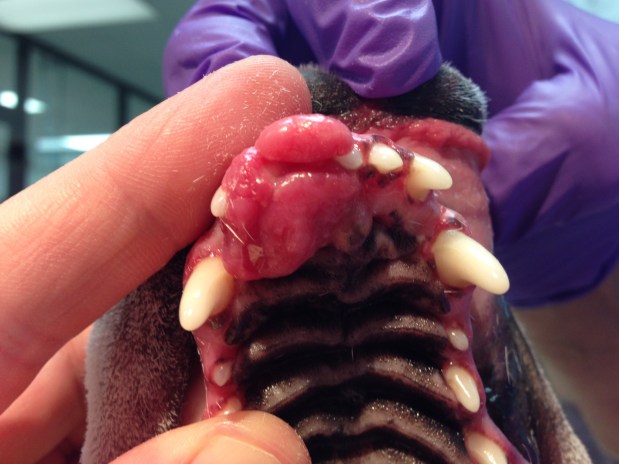
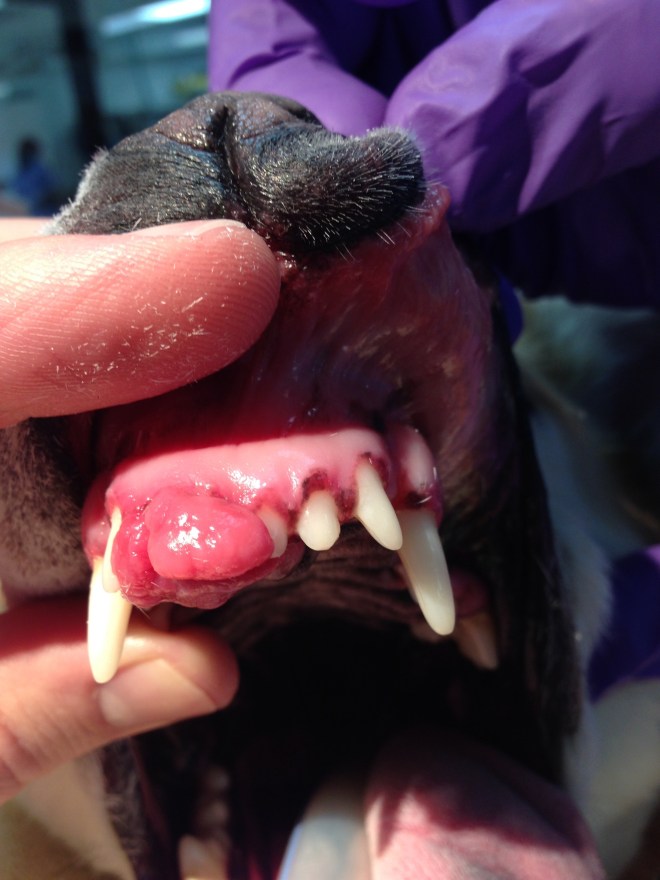
The case for this month, involves a German Shepherd mix that presented to me for a mass that was noted in the front of the mouth – incisor 1-3 on the right side of the maxilla (upper jaw). This was noted on a routine dental examination and was biopsied before seeing me. (I love it when patients come with the oral mass already biopsied – it removes that first step for me). It is very important that oral tumors are biopsied prior to developing the final surgical plan. The size/extent of the surgery is very dependent on the tumor type – some are less aggressive and require less of an extensive surgery than others. Also, knowing what we are dealing with can help us predict the course of the disease and survival times.
IMG_3834

Figue 1: Picture of the oral mass on the upper jaw.

The tumor’s biopsy results revealed that it was an acanthotamous epulis/ameloblastoma. The epulid tumors come in three varieties with this type being the most common. These types of tumors can behave locally aggressive (invading into the local soft tissue and destruction of the underlying bone), however they tend to not metastasize (spread to other organs). With this type of tumor, because it doesn’t have a tendency to spread elsewhere, the next step is to perform a CT scan of the head to evaluate the extent of the tumor, which guides us in the surgical planning for tumor removal. If the patient has other concerns, a more thorough work-up may be needed (chest evaluation and abdominal ultrasound). A Complete Blood Count/Chemistry profile/Urinalysis is performed prior to an aggressive surgery and anesthetic event.

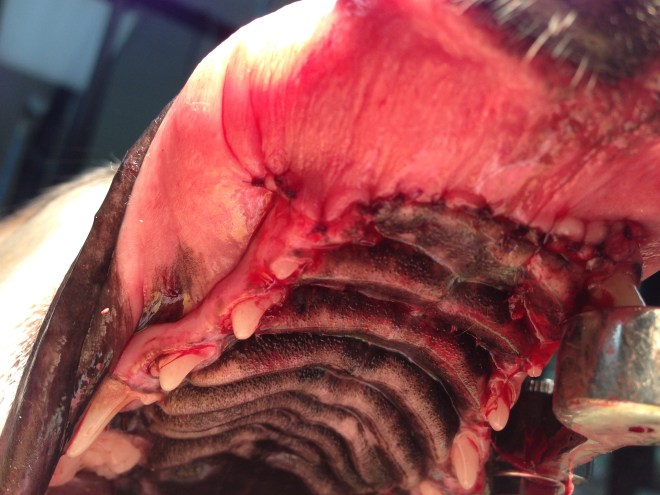
With these types of tumors, local excision is generally necessary along with removal of the underlying and surrounding bone. This is why it is so important to catch oral tumors early. I have certainly seen these tumors (among others), where they are too big to safely remove, that will still allow the pet to be comfortable and function normally. Luckily for this dog, she was able to do without the front portion of teeth and bone (incisive bone) and this left her with no visual abnormality, once her fur grew back! The last thing that we look at following surgery is our margin assessment, which tells us whether we removed it all and by how much. For this lucky girl, no further treatment was needed!
IMG_3843

Figure 2: Immediately following removal of mass and affected bone/teeth.
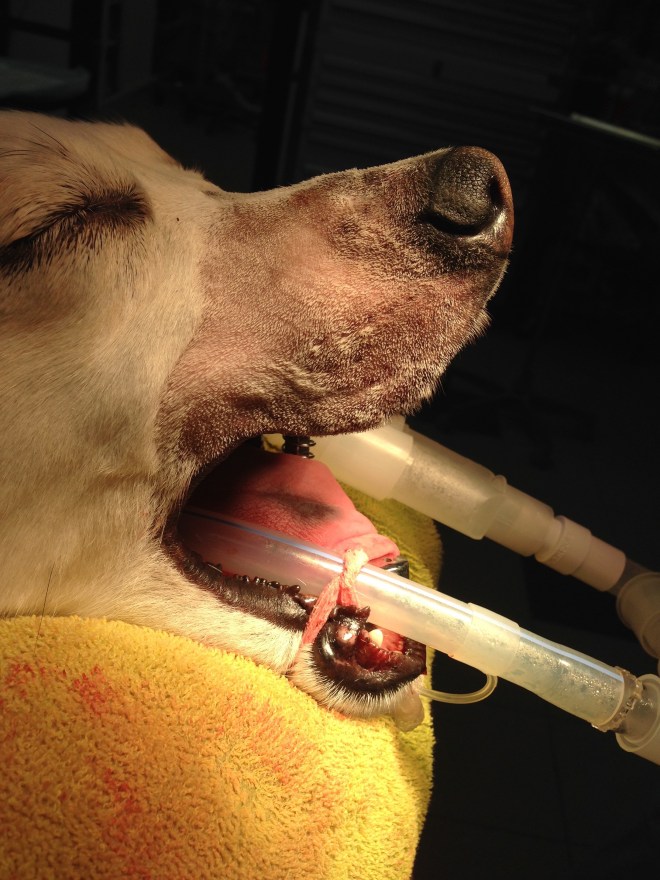
IMG_3847

Figure 3: Patient is visually normal following surgery.

 

Welcome

Welcome to “A Veterinarian’s Perspective”. Thank you for taking the time to visit this site. One of the many goals is to give accurate and useful information about a wide array of veterinary medicine topics. There are many places online one can obtain information; some “good” and some “not so good”. This site is geared to both the veterinary professional and the non-veterinary trained. Another passion and new facet to this website/blog is in the realm of business management as it pertains to the practice of veterinary medicine.  Look for some fresh, useful topics in the near future. By all means, feel free to give suggestions for topics!

Seeing the Forest Through the Trees

Seeing the Forest Through the Trees

Bainbridge Island

One of my main reasons for starting this blog was to reach people who may be in need, in distress due to the current condition of their pet, or just plain curious about different disease mechanisms. I tried to address multiple surgical conditions in the dog and cat, because I am a surgeon and try to approach things in a calculated, methodical nature. My overall goal is to help people and pets.

I never in a million years thought I would be writing articles and/or blogs (some may wish I didn’t). I do want to thank the following that I do have to this website. Writing and grammar, not arguably I’m sure, have never been my strong suit. If you wondered if I was a little off, you probably could have guessed – I am LEFT handed. Yes folks, I follow in the footsteps of some famous people: Michelangelo, Ty Cobb, and the list goes on. You would have thought that being left handed would have made me right brained and lean towards, the arts, writing, etc, however I don’t and I am sure my high school English/grammar teacher would have a visceral, gut wrenching response to my writings (I am trying extra hard to paint a picture, just for her).

While I will continue writing posts about disease processes and various cases that are seen through the hospitals at Affiliated Veterinary Specialists, I would like to change focus from time to time, addressing topics that may surpass the practice of veterinary medicine and deviate into the emotional, communication, and management world. How many times have we found ourselves immersed in situations where we have been overwhelmed either with the medical condition of our pet or the declining medical condition of a loved one and thought “if only my doctor would listen to me, to my questions, and concerns”? At times we may feel like the tree falling in the middle of a dense forest – never heard or noticed. At times, we may be the doctor who is trying their best to communicate the gravity of a medical condition to a client or patient and don’t know how to chose our words properly or are rushed by the overbooked schedule we allow. It is not that there is fault to be given, but is there a better way, can we teach ourselves to be a more articulate, caring professional? Can we manage our time better to be a more caring and compassionate professional; for that matter can we maximize our time both at work and at home? How many times do we feel drained emotionally when we come home and don’t have enough compassion for the ones who are supposed to matter most to us? What is the bigger picture, can we “make out the forest through the trees”?

Obviously, there are a lot of topics to discuss and with time and diligence we will cover the big topics. I will try to pull from my own life lessons and the life lessons of others, both professionally and personally (and I will try to make them short and light if possible). As a professional, there are times I do my job well and there are certainly times that I could have communicated differently or acted differently for a more desired outcome. I do expect that some of my future topics will leave me open and vulnerable. I am always open to constructive criticism. For me this altered direction is about self improvement as well – ask my wife how well I separate work and home life, on second thought don’t.

I will leave with this one thought (OK it will be a long thought, I am long-winded). I remember vividly January 1, 2000 sitting in the packed waiting room of a hospital emergency room, while my grandfather was being admitted for congestive heart failure. Being twenty-one years old and that it was New Year’s Day, this wasn’t exactly what I had in mind to say the least. I would have rather been home watching bowl games and celebrating the new year with my friends and family, however I learned a very important lesson that I have taken with me since that lonely day. It was just me in the waiting room filled with people waiting their turn, some in more serious condition than others (many nursing their New Year’s Eve hangover). I can remember the scene like it was yesterday: an elderly man in a wheelchair came up to me and we exchanged the normal small talk and discussing the football games that were being played that day. He asked me where I went to school and what my plans were after school. My answer was well rehearsed, since I knew that I wanted to be a veterinarian from a very early age. I told him my current status of having applied to various veterinary schools when he abruptly stopped me and gave me this word of advice: “No matter what you do, if you are able to help people and animals ALWAYS treat that opportunity as a blessing and a privilege”. It was obvious that he had his run in with the medical profession and I am sure he had both positive and negative experiences. He was right, I was blessed, I had my veterinary school interview at Ohio State University (where I would eventually attend) the day before my grandfather passed away – it was his dream that I go to veterinary school. That man, whom I do not know his name and can barely remember his face, touched a young man that day and it is my goal to impact others in a similar way.

Kevin Benjamino, DVM, DACVS

Copyright 2015