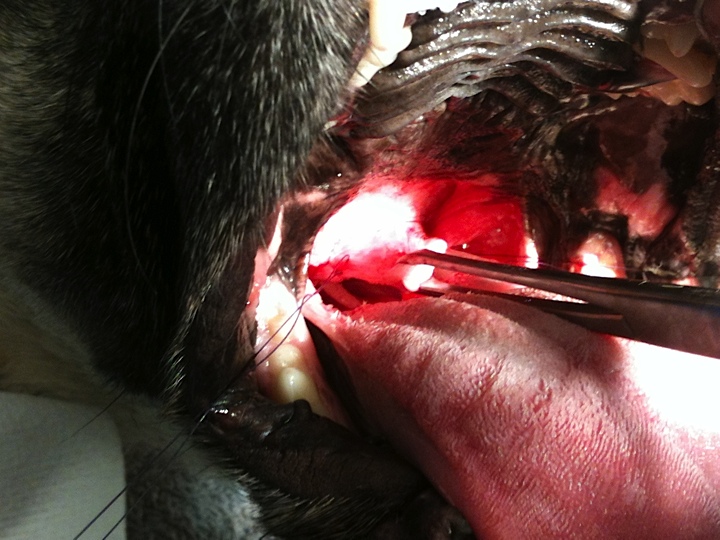
Elongated soft palate
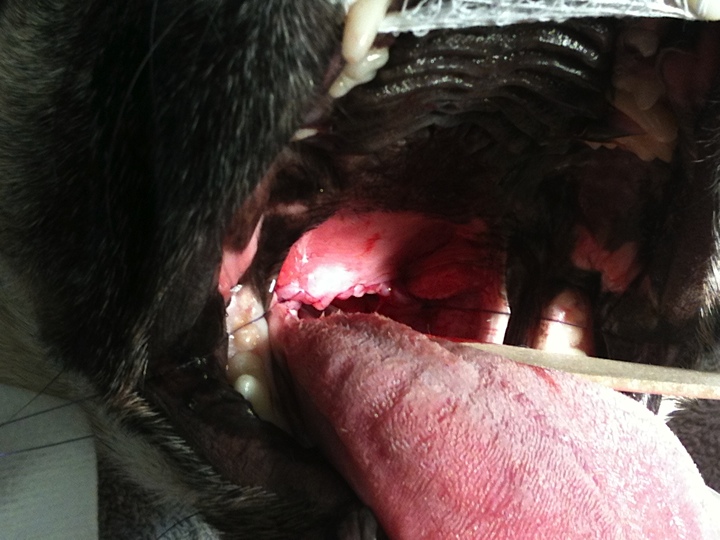
Shortened soft palate
The mainstay of treatment for BOAS remains surgical, however some medical measures can also be taken. When considering medical management, it is important to focus on factors that can cause worsening of the signs, such as weight loss and allergies. Other factors to consider are housing the patient in a cool environment, avoiding the use of neck leads, decreased activity levels and the use of gastroprotectants for any concurrent vomiting or regurgitation. Typically medical management is used after (and in conjunction with) surgical management.
There are many questions that arise when considering surgical management and one of the biggest is when do you consider surgery? BOAS can be seen even in puppies and it is recommended that an evaluation be performed in dogs that are predisposed to this condition. Early management can halt or delay the progression that is typically seen, especially laryngeal collapse.
There are various methods to widen the nares(nostrils). The most common technique is the vertical wedge resection, where a wedge of tissue is removed with the apex of the triangle at the dorsal surface. An absorbable suture can be placed to control bleeding. It is important to make sure that the nares is wide enough to increase airflow.
An elongated soft palate is one of the most common features of BOAS. The assessment and skilled resection is key. If too much is removed, then there is a communication between the oropharynx and nasopharynx. If not enough is removed then the problem still exists. The most common technique employed is resection with metzenbaum scissors and suture. Sharp excision of the soft palate generally ensures the least amount of inflammation. Other methods, such as CO2 laser and Ligasure, have been described and can be successful. Complications that can arise are as follows: bleeding, inflammation, chronic granulation tissue formation, and further elongation of the soft palate over time.
As mentioned previously, the presence of everted saccules characterizes the patient with stage I laryngeal collapse. There is some controversy as to whether or not everted saccules should be addressed surgically.
With patients that have grade II and III laryngeal collapse surgical correction is more difficult. When collapse is present it is always recommend to correct what is correctable, however the larynx will never be functional again. Some propose modified laryngeal tieback procedures with mixed outcomes. A permanent tracheostomy becomes a very viable option. By performing a permanent tracheostomy the entire upper airway is by-passed.
When counseling owners, generally dogs affected with BOAS have a favorable prognosis. Success is solely dependent on progression of disease. Education of owners should start when the patient is a puppy to avoid worsening. When a patient progresses to laryngeal collapse prognosis decreases greatly, as well as hospitalization time.

 A Veterinarian's Perspective