Brachycephalic Upper Airway Syndrome (BUAS) – diagnosis

Diagnostic testing:

In addition to direct visualization of structures it is wise to evaluate both the neck and chest. This is most commonly performed with radiographs (X-rays). Structures to evaluate include the oro/nasopharynx, trachea, lungs (for pneumonia, etc), and cardiac disease. If cardiac disease is suspected due to auscultation and radiographs, an echocardiogram is recommended. A complete blood count (CBC), chemistry and urinalysis should be performed prior to anesthesia to assess total body function and if your pet is a good anesthetic and surgical candidate.

A very important part of the diagnostic workup performed just before surgery is the oral examination. One way to evaluate the upper airway is endoscopy of both the larynx and esophagus. This will provide a very thorough evaluation of the soft palate, ventricles and laryngeal function.

Direct visualization is the most common way of diagnosing the associated factors of the brachycephalic dog. The nares are narrower than a normal dog and the airflow is distorted.  For a sedated oral exam, the patient is typically anesthetized (light plane of anesthesia). Evaluating the laryngeal function in these dogs is very important in differentiating laryngeal paralysis from laryngeal collapse.

The mainstay of treatment for BUAS remains surgical, however some medical measures can also be taken. When considering medical management, it is important to focus on factors that can cause worsening of the signs, such as weight loss and allergies. Other factors to consider are housing the patient in a cool environment, avoiding the use of neck leads, decreased activity levels and the use of gastroprotectants for any concurrent vomiting or regurgitation.


Brachycephalic Upper Airway Syndrome (BUAS) – physical exam

Most commonly the history of patients with BUAS are very similar. Generally, owners notice snoring and gradual progression of inspiratory stridor. Many times this will occur while the patient is a puppy and continue into adulthood. Other signs that are noted are increasing frequency of dyspnea especially during exercise or a hot environment. Another sign to look for in addition to the other is vomiting and/or regurgitation. This can be a compounding problem as it predisposes the pet to aspiration pneumonia.

On physical exam one of the first things that can be directly visualized is the nares being stenotic. The observant examiner will also note an increased upper respiratory noise with inspiratory stridor on auscultation(listening with a stethoscope. Typically the rest of the general physical examination is within normal limits.

Prior to performing a sedated oral exam various differentials should be on the list and should include neoplasia (oral/pharyngeal masses/cancer), tracheal collapse, laryngeal paralysis, lower airway disease and cardiac(heart)disease. Both lower airway diseases and cardiac disease can greatly exacerbate upper airway signs and if the patient is stable, these should be addressed first or at least concurrently.

Our next segment will be an overview of the surgical treatment and then we can wrap up this topic.

Happy Holidays

I want to take a moment to thank everyone for their continued interest and support of this blog. Your continued support has meant a lot to me and allowed me to continue to post various topics. I want to wish everyone Happy Holidays during this joyous time of the year! I wish you all the best in the New Year too! Keep your pets safe throughout this time, but definitely spoil them (we want them to ring in the New Years without any ailments)! Please continue to follow this blog!

Seasons Greetings!!

Kevin

Brachycephalic Obstructive Airway Syndrome (BOAS)

What makes up BOAS? The most common components of this disease are both stenotic nares(nostril) and an elongated soft palate. These two features are commonly seen. Other components are everted saccules, hypoplastic trachea, and secondary laryngeal collapse. In dogs that have stenotic nares the cartilage that makes up the nares is generally thicker and more condensed and oftentimes more medially displaced which causes an obstruction. Also, the conchae(cartilage in the nasal passageway) can be altered and displaced causing further airway turbulence and obstruction.

Anatomically the soft palate is just caudal(behind) to the hard palate and further divides the nasopharynx from the oropharynx (nasal passage from the mouth or oral cavity). In the normal patient the soft palate will typically extend caudally to just touch (slightly overlap) the epiglottis. In patients with an active obstruction this can be seen to extend 1-2 cm (or more) past the epiglottis. Due to this extension past the epiglottis, this tissue can actively obstruct airflow into the larynx and also become edematous(swollen) and undergo inflammation. Inflammation from this airway obstruction can extend to the tissue surround the pharyngeal region.

Generally considered to be a secondary side effect of the aforementioned conditions, everted saccules can develop due to the presence of increased air pressure of a prolonged period of time. Laryngeal saccules are normal out-pouchings noted adjacent to the vocal folds. Normally they extend outward away from the airway. After being under constant negative pressure these out-pouchings will evert and extend into the caudal laryngeal lumen causing an obstruction. Another secondary effect noted due to the constant high pressure is laryngeal collapse. This generally occurs in later stages of the disease process and will progress in severity. There is a grading scale that is used to assess the condition. Grade I laryngeal collapse is present when the laryngeal lumen is narrowed by everted saccules. Grade II collapse is characterized by both everted saccules and the cuneiform processes begin to collapse inward and fail to abduct during inspiration. Grade III collapse is characterized by the addition of the corniculate processes inwardly folding during inspiration, which signifies complete collapse.

The next posting will go over some of the physical exam findings and what we can do to help these patients out for the long run.

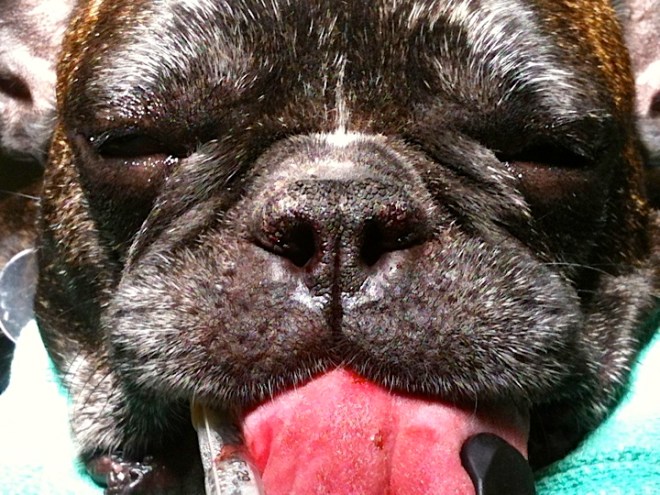
Note the narrow nostrils.

Note the narrow nostrils.

Upper Respiratory Issues – Brachycephalic Upper Airway Syndrome (BUAS)

Overview:

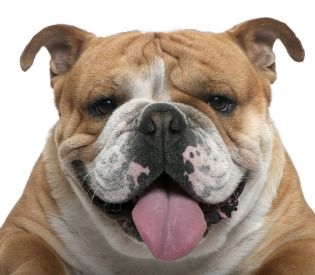
A very common airway problem seen in small dogs and some bigger dogs is a syndrome termed Brachycephalic Upper Airway Syndrome (BUAS). This disease process affects brachycephalic dogs due to the development of their skull structure. These dogs can be thought of having the same anatomy as a longer nose dog, just in a much smaller area. As one could image, this can cause difficulty in the passage of air as it traverses through the nasal passage and into the naso- and oropharynx causing an increased pressure.

Common breeds that are affected and grouped into the breed type(brachycephalic) range from the Bulldog to the Cavalier King Charles Spaniels. Dogs that are affected by BUAS can present with many different symptoms that all involve the passage of air and include snoring, stridor, exercise intolerance, apnea and even gastrointestinal side effects such as vomiting and regurgitation. There are factors that can worsen the signs such as weight gain, allergies, environment conditions etc. Factors that can be controlled should be addressed.

In the next segment we will look at the physical features of dogs that have brachycephalic upper airway syndrome. Feel free to ask questions.

Pug and stenotic nares - after surgery

Pug and stenotic nares – after surgery

Treatment for an Intestinal Obstruction

Sorry about the nearly one month lapse in writing. I think it would be good to finish the topic on intestinal obstructions. The biggest question to be asked is, once the diagnosis is made – how do we correct the issue. The answer is one of three: 1. endoscopic removal of gastric foreign material, 2. surgical removal by an abdominal exploratory (or laparoscopy – only if a focal obstruction), and 3. hospitalization and fluids, if and only if , the foreign material is diagnosed as being in the large intestine/colon.

Generally, surgical explore of the abdomen and removal via a gastrotomy, enterotomy, or intestinal resection and anastomosis is recommended. Rather than go into the technical aspects of the surgeries, it would be better to put the emphasis of the importance of early detection and treatment of an intestinal obstruction, especially a complete obstruction. The biggest worry is both where in the gastrointestinal tract and to what extent did the material cause damage to the intestine. This can range from irritation and inflammation to perforation and necrosis (death) of the affected intestine. Early intervention is key in trying to reduce the risk of extensive damage. The more aggressive the procedure required increases post-operative risk to the patient.

Most patients will do well with surgery and recover uneventfully. Standard enterotomies and resection/anastomosis have a 10-15% complication rate when performed according to the literature. The most concerning complication is termed dehiscence (leaking of the intestinal suture line) and require another surgery to repair the area. Unfortunately, with more surgery required, the complication rate increases.

The best word of advice would be to attempt to identify possible foreign bodies and remove them them your pets reach. Some examples would be torn pieces of toys, squeakers from toys that have been removed, string/fishing line from cats, etc. However, if you do find your pets have the common signs – seek veterinary help right away.

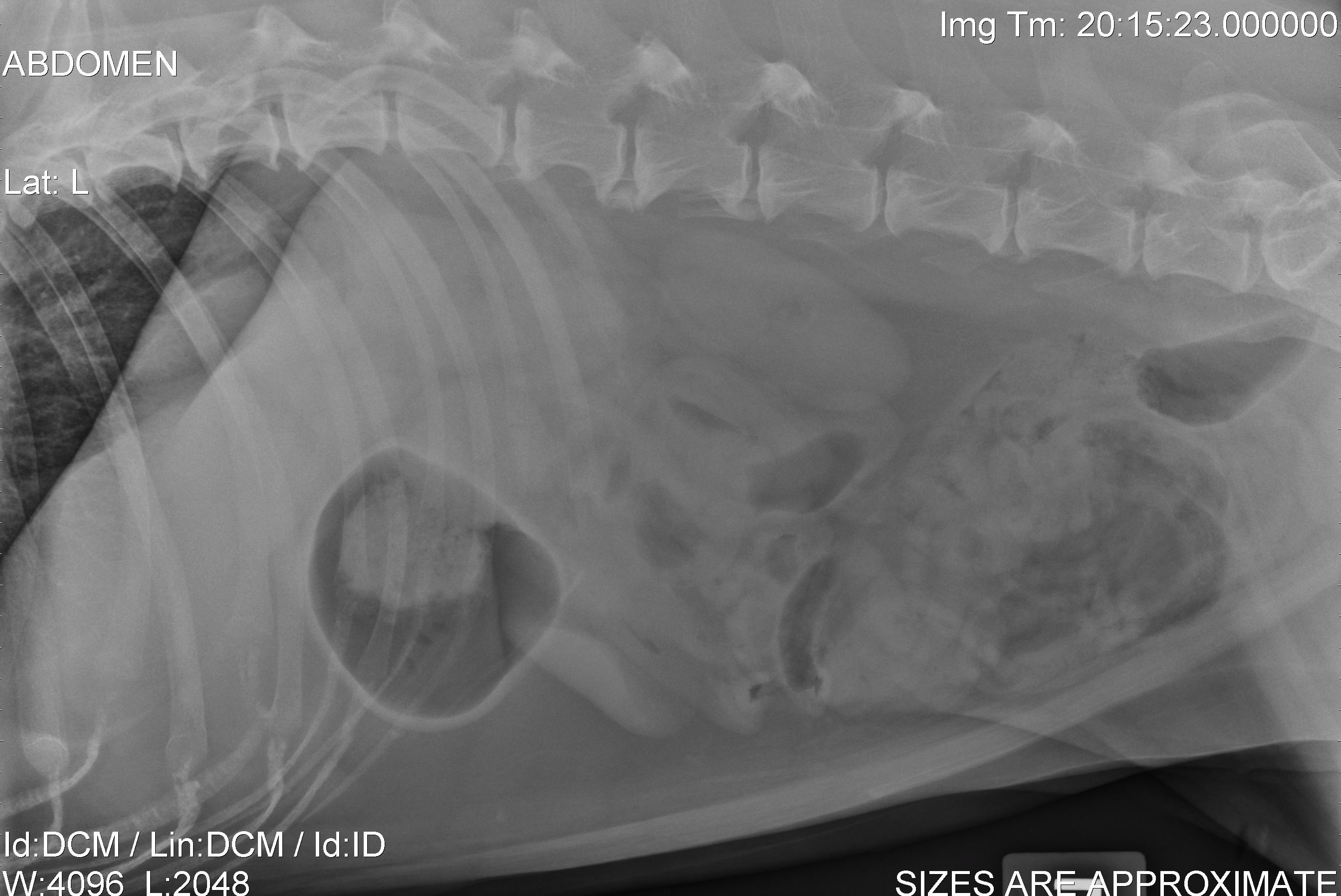
An x-ray of a foreign body both in the stomach and within the intestines.

Common Signs with Intestinal Obstructions

Welcome back. This shouldn’t take too long, but let’s review some of the more common signs seen with intestinal obstructions. The most common sign would be vomiting and generally not a one time occurrence. This will usually be profuse vomiting (but can vary with every patient). Other signs to look for is anorexia (not wanting to eat), lethargy, and abdominal pain. As with any type of foreign body the gastrointestinal tract can become perforated and significantly worse signs can become evident. Whenever an intestinal foreign body is suspected immediate veterinary care (whether your primary veterinarian or an emergency clinic) is highly recommended. Generally these signs will occur very acutely (all of a sudden) once the object begins to obstruct the intestine. We don’t always know what our dogs get into, especially if they are left unattended or go outside in the back and unsupervised. It seems like many owner don’t know what there pet got into and swallowed.

During the initial evaluation, your veterinarian may recommend some diagnostic tests to help support the diagnosis of an intestinal foreign body and justify surgery. Most of the time the physical exam will show, dehydration (high heart rate, dry mucus membranes, etc), evidence of vomiting, pain on abdominal palpation, fever (if perforated intestines) and other various signs. Some dogs when presented early show few signs and are very stable, other dogs show very severe signs and may be very unstable and require aggressive supportive care including aggressive fluid management and other treatments.

The standard diagnostics after initial triage (physical exam, blood pressure, etc) typically include abdominal radiographs (x-rays), complete blood work, possible chest radiographs (if aspiration suspect or in the geriatric dog) and possible abdominal ultrasound if the radiographs are non-diagnostic. Some may also recommend contrast radiographs with barium contrast in an attempt to highlight the foreign body.

Once a presumptive diagnosis is made and the patient is deemed stable surgery generally is the next step. If the foreign body is only in the stomach, endoscopy may be performed succesfully to remove the object.

Intestinal Obstructions

Hello all!!! I hope everyone is well!!! It has been a busy past few weeks. I recently was in Mexico lecturing, which was very exciting, my first international lecture series. Everyone was great in Mexico, very hospitable, I hope to be invited in the future. The next few weeks will prove to be busy as well – we will see how things go – stay tuned for updates.

I was trying to think of topics to share that might be beneficial for both owner and professional, and thought I would share a little about gastrointestinal obstructions – namely foreign bodies/materials. As a general surgeon, intestinal foreign bodies and obstructions are a common reason to go to surgery. Countless times per week we are faced with the decision of surgery in intestinal obstructions. While eating a foreign body is a major way of causing an obstruction, there can be other reasons as well such as cancer, etc. We will stick to foreign body obstructions in this blog.

Defining the terms: Foreign body refers to any material (ingested, in this case) that is foreign to the body. We are referring to objects swallowed by an animal and can range from fabric, stick, coins, tennis balls, rocks, etc. When an animal ingests an object there are three possible outcomes: 1. passing the object and excreting it in the feces, 2. becoming partially lodges in the stomach or intestines and partially blocking the normal flow of contents, and 3. becoming lodged in the stomach (pylorus) and/or intestines and causing a complete obstruction, not allowing any gastrointestinal contents to pass. These can also occur in the esophagus too.

Now that we got that out of the way, we will start talking about common signs you may see with your pet when they swallow a foreign object. Stay tuned!!!

Minimally Invasive Surgery – Thoracoscopy

Thoracoscopy is the use of a rigid scope to evaluate the thoracic cavity. Typically this is performed in either dorsal recumbency (on their back) or lateral recumbency (on side) and involves an average of 3 portals. These patients typically experience a marked decrease in pain post-operatively when compared to a lateral thoracotomy or median sternotomy (open chest procedures).

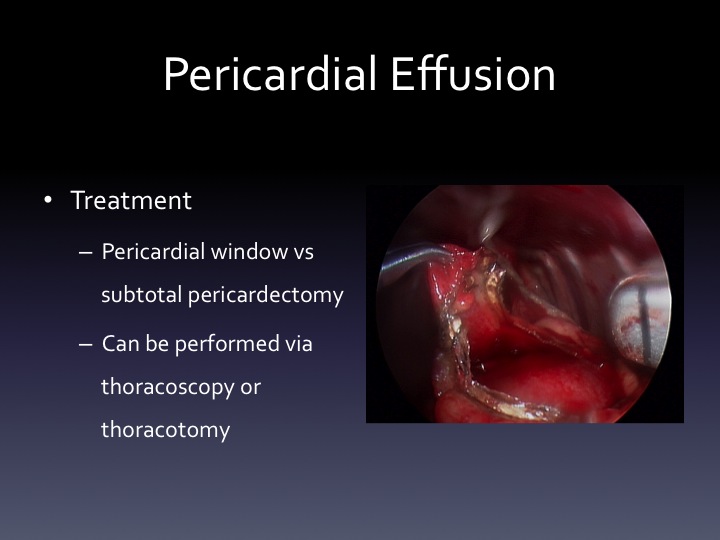
Indications for thoracoscopy are as follows (not limited to): exploration of the thoracic cavity, pleural effusion of unknown origin, idiopathic pericardial effusion, lung resection, vascular ring anomaly, biopsies of the chest cavity, lymph node biopsy, pyothorax evaluation, etc. When appropriate, the major advantage is patient comfort, decreased morbidity, and in many cases better visualization. One of the most common reasons for thoracoscopy is pericardial effusion. This can be idiopathic, neoplastic or inflammatory. Therapy for pericardial effusions could include a pericardial window which can be done via thoracoscopy. Common risks with this procedure are as follows: herniation of the heart, fibrosis of the window, and continued hemorrhage.

Results of thoracoscopic pericardial windows are usually very successful when performed in the appropriate patient. It can provide long-term resolution in patients with idiopathic effusion and inflammatory disease. Quality of life can be improved in cases with cancer.

Overall, thoracoscopic procedures are increasing in popularity. The thought of being able to address surgical problems with minimal incision versus using large invasive incisions is very attractive. Please feel free to discuss these options with your veterinarian or veterinary surgeon.

Pericardial window being performed with Ligasure.

Previous article regarding prophylactic gastropexy and ovariohysterectomy!

Minimally Invasive Spay and Gastropexy!

More and more we hear about less invasive procedures for man, which begs the question: What can we do for our best friend? As human medicine and surgery becomes more advanced, so does surgery for our pets. Laparoscopy, which is the introduction of cameras and instruments via very small incisions into the abdomen, is one of those advances and can be used for everyday procedure such as a spay.

                Spaying (ovariectomy or ovariohysterectomy) your pet is an important part of your female dog’s (and cat’s) preventative health care plan. Its benefits include:  decreased risk of mammary cancer and uterine/ovarian cancers, infection of the uterus (which can be life threatening), etc. Spaying is recommended in any pet not being used in a breeding program.

                We typically think of a spay as a procedure that includes a larger incision on your dogs abdomen where the abdomen is opened and closed. Not anymore! We now have the ability to perform it as a laparoscopic procedure. This involves two small incisions: one that is 0.5 cm in length and the second that is 1 cm in length. All the work is performed through these two small incisions! Post-operative pain is greatly reduced and recovery time is very short, as your pet would go home the same day. An additional benefit is that there is not a larger incision to be concerned with and have to monitor.

                Another laparoscopic procedure that is becoming more commonplace is the laparoscopic-assisted gastropexy. All one has to do is watch movies or have some experience with large breed dogs to have heard about gastric dilatation and volvulus (GDV), which is the name given when a dogs stomach becomes bloated and twists on itself. This situation is a very serious condition and can be very life-threatening. It must be diagnosed and treated very quickly (hours). This condition is more common to occur in larger, deep-chested dog breeds (i.e Great Danes, Mastiffs, etc), but has been seen in many dog breeds. Unfortunately, we do not know what causes this condition; however one way to prevent it is by performing a gastropexy, which is a procedure that “tacks” the stomach to the body wall.

                A prophylactic gastropexy used to require a large abdominal incision, but not anymore. With the assistance of laparoscopy, we have been able to greatly reduce the size of the incision, decrease post-operative pain, and decrease the pet’s recovery time both in the hospital and at home. For this procedure there is a small (0.5 cm) incision made into the abdomen for the camera and a 2-3 inch incision just behind the last rib on the dog’s right side for the gastropexy – and that is it! This procedure has been shown to greatly reduce the chance of having a GDV in the future. Also, if your dog is not only a predisposed breed and a female, both a spay and gastropexy can be combined into one procedure.

                There are certainly other procedures that can be performed with these minimally invasive techniques. Veterinary medicine continues to advance and the use of laparoscopy is endless. We can use it for removing retained testicles, certain abdominal masses, gall bladder removal, etc. Also a growing field is the use of cameras and minimally invasive procedures within the chest (thoracoscopy). All these procedures are aimed at providing cutting edge techniques for your pet in order to improve your pet’s health, strengthening the bond between you and your best friend.